
Compendium
The Compendium is where the building blocks of your Realm live: notes, images, handouts, maps, and everything you want to point back to later at the table. It gives your canon one reliable home.
 Chronicle Keeper
Worldbuilding, game mastering, and players. Structure and clarity for everything.
Your growing realm needs a structured home. Chronicle Keeper connects the content of your tabletop world and makes it easy to find again, so you always keep a clear overview.
Worldbuilding and game tracking work without AI. If you want the Keeper later, you can ask for access on Discord.
One account, many realms
Each game world is its own small cosmos, whether for a D&D campaign, a The Dark Eye group, an online roleplaying setting, or your own worldbuilding. Data between your realms stays strictly separated so you can keep your focus.
Worldbuilding, game mastering, character development
Chronicle Keeper keeps world canon, session prep, and play history in one connected chronicle. Instead of juggling notes, folders, and tools, you work in one place that keeps links visible and the important answers close at hand.
Keep your Realm canon in one place and give it structure. From the first place name to the tangled history of a kingdom, your content stays flexible, connected, and easy to find again.
The Compendium is where the building blocks of your Realm live: notes, images, handouts, maps, and everything you want to point back to later at the table. It gives your canon one reliable home.
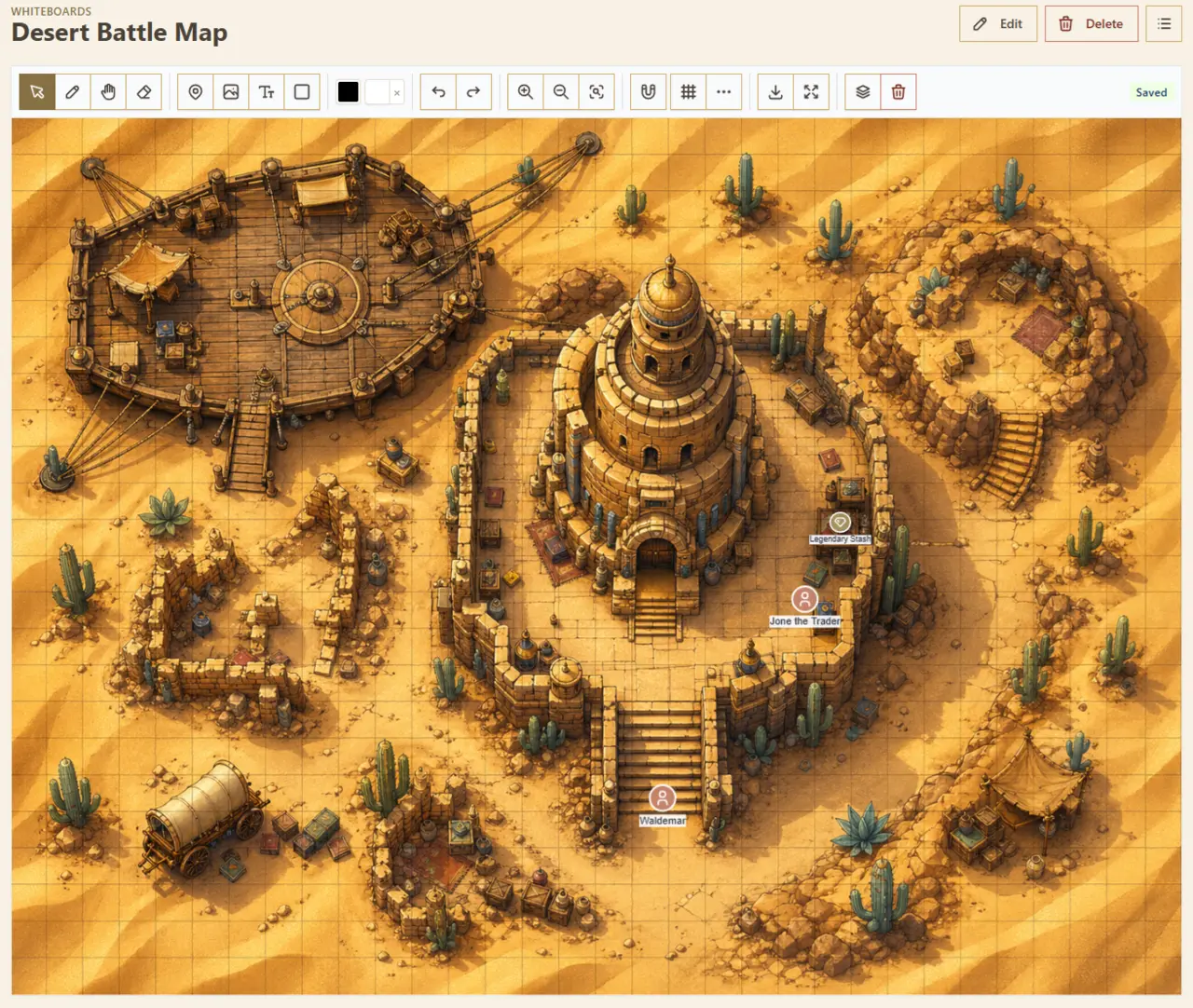
Set up maps, sketches, tactic boards, or loose brainstorms on a free canvas. Whiteboards help you place locations, show connections, and think visually while you prepare.
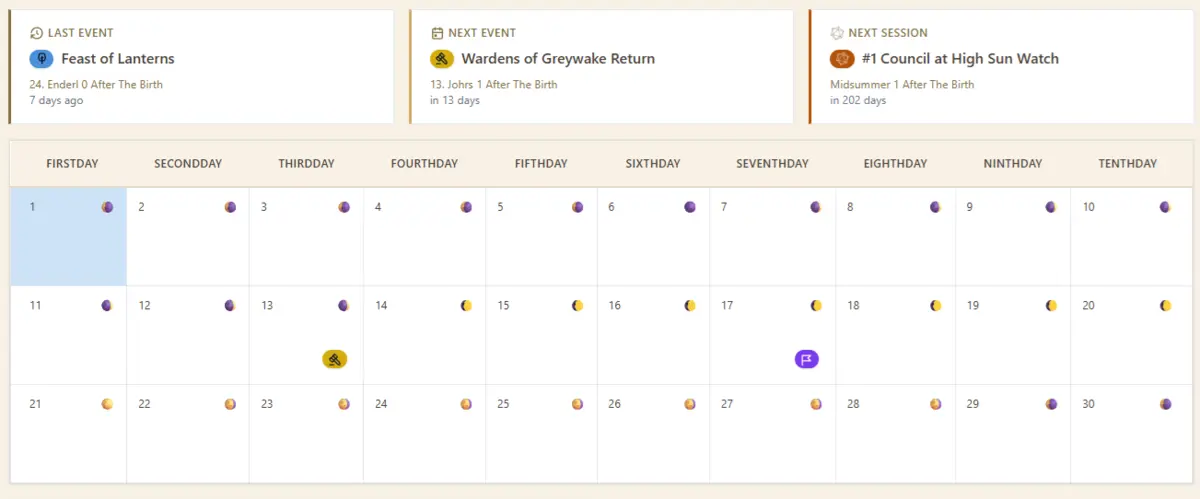
Start with an existing calendar or build one that fits your Realm. Holidays, travel, moons, and important events all get a clear place in your chronicle.
Create structured entries for people, places, factions, kingdoms, or artifacts. World Entities give your Realm a stable backbone you can later connect with Relationships, World Events, and sources.
Define your own types, icons, and colors so a large Realm never collapses into one flat list. You can tell at a glance whether you are looking at a person, a place, or an organization.
Capture the current state of your Realm. Who is allied with whom, who owes whom a favor, and which faction controls which place? Relationships turn isolated notes into solid world facts.
Record what happened in your Realm, when it happened, and which World Entities were involved. That way your timeline becomes real history instead of a pile of disconnected notes.
The world is only half the story. Plan long arcs, track open tasks, and keep Sessions in a shape your group can still read and use later.
Gather Quests into larger story arcs and keep the direction of your game in view. Campaigns give long running stories structure without flattening every side path.
From the urgent main objective to the rumor overheard in a tavern, Quests keep goals, loose threads, and concrete tasks in view. Your table always knows what it might chase next.
Plan real play sessions with agenda, notes, and recap in one place. It stays clear what your group experienced, decided, or missed, and when it happened.
Long running chronicles stay useful when you can retrieve what matters fast and connect with other players without blurring access boundaries.
Search your whole chronicle with filters for content, categories, tags, and workflow states. Even years later, you can still find that one note, lost artifact, or half-finished idea.
Connect with other Chronicle Keeper users on purpose and on clear terms. A Fellowship is a link between accounts, not silent access to somebody else’s Realm.
Hand content from your Compendium to your Fellowship on your terms, as a one-time copy or an ongoing sync. You see which fields travel, review every change before it lands, and keep it all behind a single link you can pull back anytime.
The Keeper expands the platform with direct work on your realm content. If you want AI support, it stays clearly separated, reviewable, and tied to your chronicle.
Ask about canon, prepare Sessions, or let the Keeper point out contradictions. Conversations stay available, show how the Keeper worked, and cite the sources behind each answer.
Work on your content with help from the Keeper. Refine phrasing, clean up formatting, and reuse your own saved instructions. Every proposed change stays reviewable before it becomes part of your chronicle.
A useful loop for long running games
What Chronicle Keeper is not
Not a virtual tabletop and not a live combat tracker. A knowledge Compendium for roleplaying, not a VTT.
Not a rules engine and not an automated character builder. Your world, your rules.
Not limited to D&D, Pathfinder, The Dark Eye, and homebrew tables. Chronicle Keeper stays flexible and system agnostic.
Optional Keeper support
It expands the platform with an AI tool that works directly with your realm content. In Keeper conversations you can ask about canon, trace connections, prepare the next Session, and develop ideas with visible sources instead of digging through everything by hand.
One confirmed World Event records Waldemar’s oath at the Ash Bridge with Evelyn as a witness. Session 18 and an open quest provide the play context. The sources do not establish a closer relationship, so the Keeper would label that as an inference rather than canon.
Optional Keeper extension
The Keeper expands Chronicle Keeper with an AI librarian that works directly with your chronicle. It helps you search, organize, refine, and develop ideas while staying grounded in your sources. You decide what truly becomes part of your canon.
The Keeper retrieves your documents, World Entities, sessions, quests, images, and calendar. When records are incomplete or disputed, it makes that uncertainty explicit.
Follow the Keeper’s searches, source reads, and date checks, then open the realm material it relied on.
Work on your content with the Keeper, tighten phrasing, and clean up formatting. You review every proposal before anything reaches your chronicle.
Keeper access is enabled on request for now. Ask on Discord, tell me a little about your table, and help shape where the Keeper goes next.
Privacy and ownership
Your content stays yours and is not used for AI training. The optional Keeper processes realm material only to help you, while Fellowship connections never expose realm content.
You choose what to keep and what to remove. Deleting content removes it permanently rather than leaving a hidden public copy.
A Fellowship invitation creates a mutual account connection, never access to either realm or its chronicle.
Frequently asked questions
The essentials about scope, access, AI, systems, and privacy—without making you search through fine print.
Still unsure? Ask on DiscordChronicle Keeper is a cloud-only RPG content system for organizing the canon, planning, and history of one or more tabletop realms. It brings documents, images, World Entities, campaigns, quests, sessions, calendars, Whiteboards, search, and the World Graph into one connected place.
No. Chronicle Keeper is the complete product. The Keeper is its optional AI assistant: a realm-grounded librarian for research, preparation, and reviewable writing help. Core worldbuilding and game tracking work without it.
Yes. Registration is open, and you can create an account in your browser and start a realm. The optional Keeper features are enabled on request through Discord.
Chronicle Keeper is system agnostic. You can use it for Dungeons & Dragons, Pathfinder, The Dark Eye, another published system, or your own setting because it organizes your realm instead of automating one ruleset.
No. It does not move tokens, run live combat, automate rules, or manage character sheets. It preserves the world knowledge and play context around your table and can complement the tools you already use.
A Realm is one private, separated game world with its own canon, calendar, content, settings, and history. You can keep multiple Realms in one account without mixing their data.
No. Your content is not used for AI training. If you activate the Keeper, it processes relevant realm material to answer and assist you, while you remain responsible for what becomes canon.
No. Fellowship is an invite-only connection between user accounts. It does not grant access to either person’s Realm or chronicle.
News and releases
Read the blog for release stories, background, and practical tips around Chronicle Keeper, or scan the changelog for what shipped in the newest versions.
Background, useful workflows, and a closer look at how Chronicle Keeper grows.
Privacy and Sharing ContentRead moreRead the blogRelease highlights with pictures so you can see every new capability at a glance.
Chronicle Keeper 1.3: Keeper tasks, Markdown templates, and the Notification CenterRead moreSee the changelogBuild together, experience together
Use Discord for Keeper access, rough edge reports, feature ideas, and direct contact with me. Chronicle Keeper grows with real tables, so thoughtful feedback is heard here and often shapes the next step.
